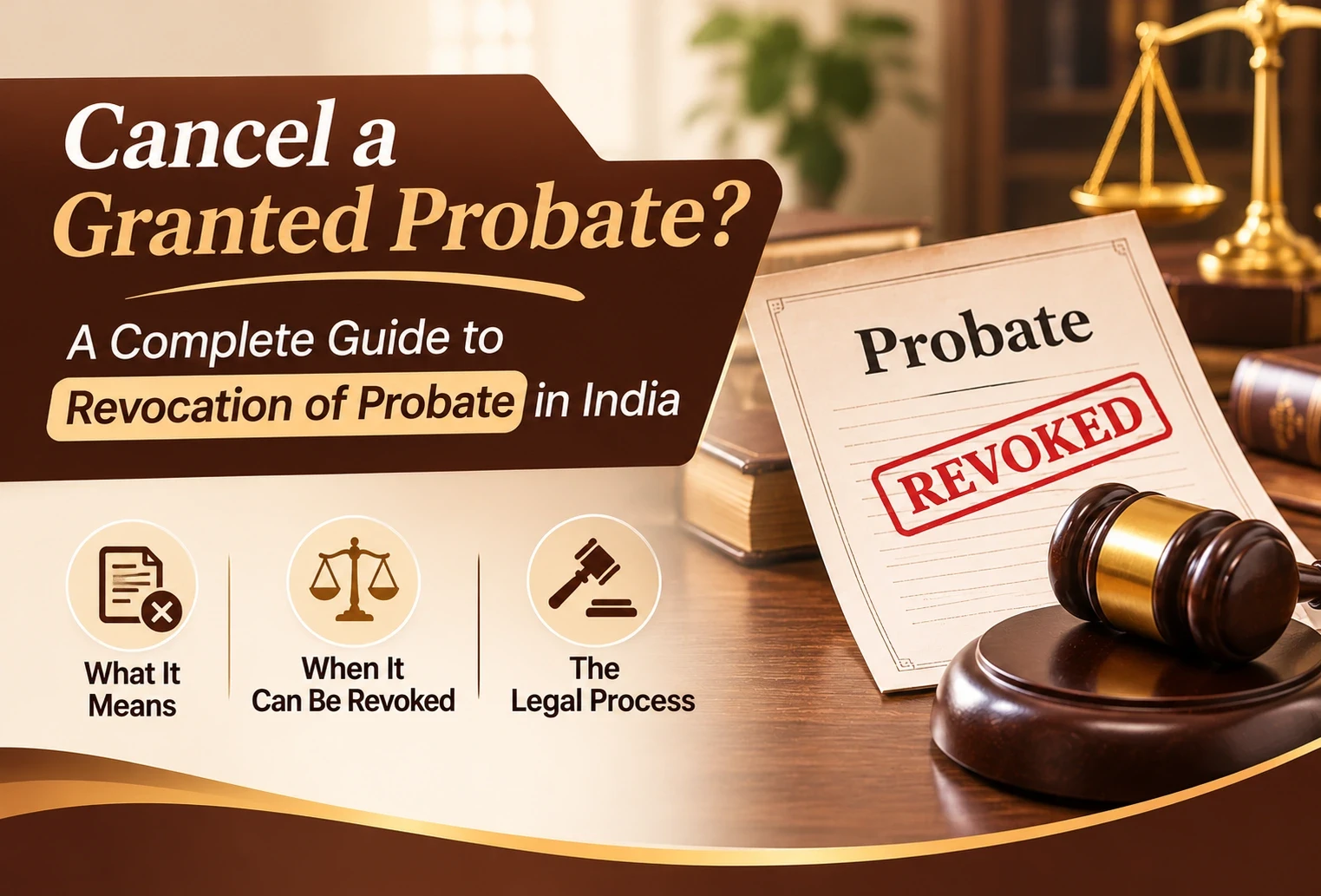
Revocation of probate in India is a court order that annuls a grant of probate or Letters of Administration which was granted for a will of the deceased testator to the executor. A court can revoke a grant of probate under Section 263 of the Indian Succession Act, 1925, but only if "just cause" is shown, such as fraud, concealment of material facts, a defective procedure, or non- impleadment of necessary parties.
The application for revocation of grant of probate must be filed within three (3) years from the date the right to apply arose. This guide explains the grounds, the people who can apply, the court, the time limit, the procedure and the effect of revocation.
What Is Probate and Why Is It Treated as Conclusive Proof of a Will?
Probate is the process wherein the genuineness or veracity of the Will is legally confirmed by the judicial authorities. A Probate of will is the legal process through which a competent court certifies that a Will is genuine and valid, thereby authorizing the executor to administer the estate of the deceased in accordance with the wishes expressed in the Will by the deceased testator.
Our guide on probate of a will explains how the grant of probate is obtained.
Under Section 273 of the Indian Succession Act, 1925, a probate is conclusive proof of the legal character of the person to whom it is granted, throughout India, for as long as it is not revoked. This is why banks, land registries, registrars and other authorities rely on it. It is also why a probate cannot be ignored or challenged casually. It stands until a court sets it aside.
What Does Revocation of Probate Mean Under Section 263 of the Indian Succession Act?
Section 263 of the Indian Succession Act, 1925 allows a court to revoke or annul a grant of probate or letters of administration for just cause. Once the grant of probate is revoked, the executor cannot act in accordance with the terms of the will and must return the probate certificate to avoid its misuse.
It is important to point out that revocation proceedings are not appeal. Rather, such proceedings challenge the grant of probate by satisfying the court that a “just cause” exists.
What Counts as "Just Cause" for Revoking a Grant of Probate?
The Explanation to Section 263 lists situations in which just cause is deemed to exist. Each one is a separate ground. The Explanation to Section 263 states as below-
“Just cause shall be deemed to exist where—
-
the proceedings to obtain the grant were defective in substance; or
-
the grant was obtained fraudulently by making a false suggestion, or by concealing from the Court something material to the case; or
-
the grant was obtained by means of an untrue allegation of a fact essential in point of law to justify the grant, though such allegation was made in ignorance or inadvertently; or
-
the grant has become useless and inoperative through circumstances; or
-
the person to whom the grant was made has willfully and without reasonable cause omitted to exhibit an inventory or account in accordance with the provisions of Chapter VII of this Part, or has exhibited under that Chapter an inventory or account which is untrue in a material respect.”
The Hon’ble High Court of Delhi in K.P.R. Nair v. Meenakshi Sardana & Anr., FAO 288/2023, in para 32 held as under:
“32. It is pertinent to mention that the plea by the learned counsel for the appellant that unlike a petition under Section 278 of the ISA, there is no legal mandate to supply the details of the family or other relatives of deceased and their respective residences was brushed aside by the Supreme Court holding that grant under the aforesaid provision could be revoked or annulled in terms of Section 263 of the ISA. It was held that non-impleadment of parties in such proceedings, which ought to have been cited shall be deemed to be a ‘just cause’ for revocation or annulment of the grant”.
Illustrations Of Situations Where a Will Can Be Revoked
-
Court by which the grant was made had no jurisdiction.
-
The grant was made without citing parties who ought to have been cited.
The Supreme Court in S. Leorex Sebastian & Anr. v. Sarojini & Ors., 2026, in para 24 held as under:
“24. Despite which, she did not implead her two brothers/their legal heirs and the present appellant as party respondents in the said proceedings. Thus, it can be said that the respondent no. 1 herein obtained the order of grant of probate in her favour by suppressing material facts, and no citations were issued to the brothers of the respondent no. 1/their legal heirs and the present appellants, before the grant of probate. Hence, the District Court was justified in revoking the order of grant of probate in favour of respondent no. 1.”
-
The Will of which probate was obtained was forged or revoked.
-
A obtained letters of administration to the estate of B, as his widow, but it has since transpired that she was never married to him.
-
A has taken administration to the estate of B as if he had died intestate, but a will has since been discovered.
-
Since probate was granted, a latter Will has been discovered.
-
Since probate was granted, a codicil has been discovered which revokes or adds to the appointment of executors under the Will.
-
The person to whom probate was, or letters of administration were, granted has subsequently become of unsound mind.
Can a Probate Be Revoked for Forgery, Undue Influence or Lack of Notice?
A probate can be revoked on the above stated grounds which are considered as just cause by the Courts.
-
Forged will: If it is established that the will in question i.e. the will of which the probate has been granted itself is a forged document, then the very foundation of the proceedings become vitiated and becomes a just cause for the revocation of probate.
-
Undue influence or coercion: If it is found that the signature on the will qua which the probate is granted was obtained by undue influence or pressure and lacked free consent, the probate so granted deserves to be revoked.
-
No notice to legal heirs: A probate obtained without citing the legal heirs of the deceased i.e. without impleading them as parties to the probate proceedings renders the probate so granted vitiated by fraud. Concealment of such material fact i.e. non-impleadment of necessary party goes to the very root of the case and renders the entire proceedings as nullity.
-
Later will found: In cases where there is a discovery of a new later will or any party sets up before the Court any subsequent Will, the earlier Will becomes a subject matter of challenge thereby rendering it as a ground of revocation.
However, there is no straight-jacket formula and every case stands on its own facts and the Courts have to weigh each side’s averments to reach to a conclusion. For a wider view of how wills are contested, see our guide on grounds for challenging a will in India.
Who Can File a Petition for Revocation of Probate?
A person who has a genuine interest in the estate and can establish a just cause, can file for revocation proceedings such as-
-
Class 1 Legal heirs who were not impleaded as parties in the probate petition
-
Beneficiaries under an earlier will
-
Persons whose rights in the property are affected by the grant
A stranger with no interest in the estate cannot ordinarily seek revocation.
Which Court Has Jurisdiction to Revoke a Probate?
Under Section 264 of the Indian Succession Act, 1925, the District Judge has jurisdiction in granting and revoking probates and letters of administration within the district. In practice, the petition is usually filed before the court that granted the probate.
In a few states, the rules may be different and hence it is prudent to confirm the correct forum before filing. You can read more about our High Court advocate services in Delhi.
How Does the Procedure for Revocation of Probate Work, Step by Step?
The exact steps depend on the court and the facts, but a revocation case generally moves as follows.
-
Case assessment. An Advocate reviews in detail all the documents placed before him by the client to see whether any ground is made out for revocation of the will in terms of Section 263 of the Indian Succession Act.
-
Filing the petition. An application seeking revocation is then drafted and filed before the court that has jurisdiction. It sets out the applicant's interest in the estate, the relevant facts and the grounds under Section 263.
-
Notice to the other side. The court after being satisfied about the prima facie existence of the case, issues notice to the executor or the person who obtained the grant, and also to other interested persons in those proceedings for them to put forth their case. the same works on the principle of natural justice or the doctrine of Audi Alteram Partem i.e. “let the other party be heard” or “nobody should be condemned unheard”.
-
Written statement and issues. The respondent/s files a reply to the revocation application and puts forth his/her case as to why the revocation should not be effected and thereafter the Court takes a view as to whether decide the application summarily based upon the material available on record or to try it as a civil suit under Section 295 of the Act. If the Court deems it fit to try the matter as a civil suit then the issues are framed.
-
Evidence. In this stage of the proceedings both the sides appear in the witness box to state their case and the other side cross examines them. The said stage also consists of calling of any witness with the permission of the court to support their case which may include witnesses to the will, handwriting evidence and documents from the original probate case.
-
Arguments and judgment. Once all the above stages are done with, the Court then hears the arguments from both the sides and the matter is then decided based upon the documents, evidence, etc. to see whether just cause exists. If it does, the grant is revoked or annulled. If not, the petition is dismissed.
What Documents Are Needed for filing a Revocation of Probate Petition?
The generally required documents are as below:
-
Proof of the applicant's relationship with the testator, such as a family tree or legal heir certificate
-
Details of the assets- whatever is known at the moment
-
Proof showing when and how the applicant first came to know of the probate (important for limitation)
-
Evidence of the ground relied on, such as suppression of a material fact, concealment or non-impleadment
-
Identity and address proof of the applicant
What Happens After a Probate Is Revoked?
When a court revokes a probate, the executor's authority under that grant ends, and the estate can no longer be dealt with on the strength of that grant. The court may also pass directions about the return of the original probate and about how the estate is to be handled. Depending on the outcome, a fresh grant may be sought, or the estate may pass under the rules of intestate succession if no valid will remains. Actions taken in good faith before revocation may be treated differently from later actions, so the effect on third parties depends on the facts.
How Is Probate Different From Letters of Administration and a Succession Certificate?
These three documents are often confused.
|
Document |
When it is used |
What it does |
|---|---|---|
|
Probate |
Probate is obtained when the deceased passed away leaving behind a will that names an executor |
Confirms the genuineness of a will. |
|
Letters of administration |
LOA is obtained when the deceased passed away intestate or the will names no executor, or the executor cannot/does not want to act as the executor. |
Appoints an administrator to manage the estate |
|
Succession certificate |
A succession certificate is obtained where there is no Will and the estate of the deceased consists of movable assets only such as bank deposits, shares, stocks etc. |
Gives the holder the right to collect those specific assets |
A succession certificate can also be revoked by the court under Section 383 of the Indian Succession Act, on grounds that are similar in spirit to those for probate. If a bank is refusing to release a deceased person's funds, read our article on a bank refusing to release deceased funds.
What Mistakes Should You Avoid in a Revocation of Probate Case?
-
Delay in filing- The limitation with respect to filing of revocation of probate is strict and hence it is important to act promptly upon knowledge.
-
Filing without a clear ground- If you are dissatisfied with the devolution of assets in the Will left behind by the deceased, that is not a strong enough ground for filing of revocation. Therefore, “just cause” must be identified while filing for such proceedings.
-
Creating third party interest- While filing for revocation, a stay application must also be moved to prevent creation of any third-party interest in the assets left behind by the deceased.
-
Forum- Filing in a court without jurisdiction wastes time that may not be recoverable.
How Can Malik Law Offices India Help With a Probate Revocation Matter?
In order to file for revocation of Probate, the process requires good prior experience and careful examination of the facts of the matter. Malik Law Offices India, a Delhi NCR-based law firm, advises families on wills, succession and probate matters, including petitions to revoke a grant of probate and has handled multiple such matters. Our Advocates review the will, the probate record and the timeline, explain whether a ground under Section 263 is available, and guide you on the correct court and the next steps.
If you believe a probate was obtained improperly, or if a probate you hold is being challenged, you can reach out to us.