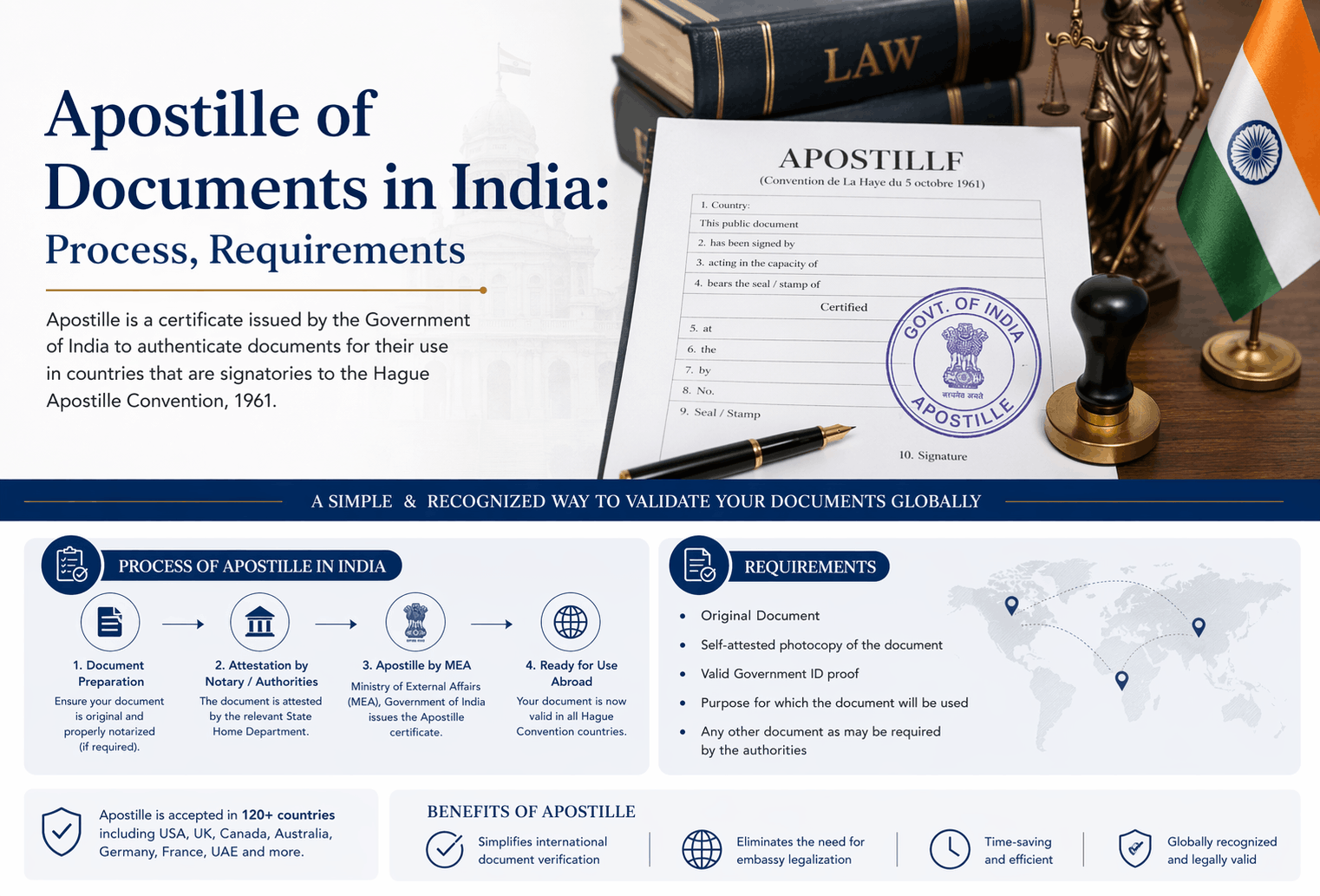
Since the year 2005, India is a member of the Hague Convention of October 5 1961, that abolished the requirement of legalization of foreign public documents and implemented a simplified, internationally recognised method of document authentication known as Apostille.
Apostille Documents is an essential procedure for individuals and businesses seeking to use Indian public documents abroad, which is acceptable in all member-countries of the Convention. As India is a member of the Hague Apostille Convention, 1961, no further attestation or legalization of a document apostilled by a member country, should be required for using such apostilled document in India. An apostilled document should, therefore, be treated as legalized document for all purposes in India by all concerned, in accordance with the international obligation under the Convention.
What Is Apostillization?
Apostille attestation meaning can be understood as follows: an Apostille is an official certificate attestation issued by a designated government authority, which generally consists of:-
The apostille seal/stamp of the Ministry of External Affairs with a unique identification number (UIN), certified by the Section Officer, MEA
The seal/stamp of the Home Department
Seal/Stamp of the Notary Public
Once a document has been apostilled, it becomes valid and acceptable in all Apostille Convention member countries, without the need for further diplomatic or consular legalization. However, it is important to note that the validity of apostille documents in India and abroad depends on the accepting country's own requirements always verify with the foreign authority.
When Do You Need an Apostille?
Documents often require apostillization for the following purposes:
For education purposes overseas.
For employment purposes overseas.
For Immigration, citizenship and residence applications.
Setting up of business overseas.
Obtaining Overseas Citizenship of India. Personal matters, including apostille birth certificate India requests, apostille marriage certificate verification, affidavits, and single-status certificates.
Documents Eligible for Apostille
Apostille can be obtained for the following documents, including but not limited to:
1. Personal Documents- Personal document attestation covers a wide range of civil records. Common documents eligible include-
Birth certificate- Frequently required as part of birth certificate attestation for immigration or OCI applications.
Marriage certificate- Apostille marriage certificate India requests are among the most common, particularly for couples emigrating or applying for spouse visas. Marriage certificate attestation is required by many countries before issuing residency permits.
Divorce decree
Death certificate
PCC (Police Clearance Certificate) PCC Apostille is required for employment and long term visa applications abroad. The PCC must first be verified by the state police department before being submitted for MEA apostille stamping.
Single status certificate.
Affidavits.
Power of Attorney.
2. Educational Documents Educational certificate attestation often referred to as HRD attestation is the pre-verification step required before MEA apostillization. Covered documents include:
Degrees and diplomas.
Mark sheets.
School leaving certificates.
Matriculation certificate.
3. Commercial/Corporate Documents
Certificate of incorporation.
Memorandum and Articles of Association.
Board resolutions.
Powers of Attorney.
Business agreements.
Authority Responsible for Apostillization in India
In India, only the Ministry of External Affairs (MEA) is empowered to issue Apostilles, through the MEA Branch Secretariats and thespecific outsourced service providers approved by the government.
Step-by-Step Process of Apostille Documents in India- Understanding how to apostille a document in India involves three structured stages:
S.No
Steps
Description
Step 1
Pre-Verification
As the first step, the document submitted for apostillization is required to be authenticated by either:
State Home Department – for personal or civil documents
HRD or Department of Education – for educational degrees/certificates
Chamber of Commerce – for commercial or business documents. This document attestation step is mandatory before MEA submission.
Step 2
MEA Apostillization
Once pre-verified, the document is submitted to MEA for apostille stamping. The MEA affixes:
A computer-generated Apostille sticker with a Unique Identification Number (UIN).
A QR code that can be verified online by foreign authorities. This constitutes the final apostille attestation of the document.
The Apostille itself includes details such as the issuing authority, document type, and official signature.
Step 3
Document Collection
After processing, (typically 3–10 working days) the apostilled document is returned and is valid to be used in all Hague Convention countries. For embassy attestation requirements (non-Hague countries), a separate process through the relevant embassy applies.
Benefits of Apostillization
Apostillization has turned out to be a swift and uniform method of authentication, valid and accepted directly in all Hague Convention member countries
It simplifies verification for immigration, study, and employment.
It is cost and time efficient process.
Physical presence may not be necessarily required for the process to be concluded.
Conclusion
Apostillization is a vital process for the global acceptance of Indian documents. Understanding the steps, requirements, and legal framework can help individuals and entities streamline international applications, avoid delays, and ensure compliance with foreign regulations. With India’s participation in the Hague Apostille Convention, document authentication has become far more efficient and globally recognized.
Frequently Asked Questions
It is required to use one’s Indian documents overseas i.e in Hague Convention countries, for study, work, immigration, or business purposes.
Only the Ministry of External Affairs (MEA) is authorized to issue Apostilles.
Personal, educational, and commercial documents issued in India can be apostilled.
Yes, originals are required for verification and apostillization.
It generally takes 3-10 working days depending on document type and state verification.
Apostille is not valid in all countries. Rather, it is valid only in member countries of the Hague Apostille Convention.
An apostille may be rejected in case of any errors, mismatched details, unclear seals, or lack of proper pre-attestation.
No, Apostille only authenticates the document and therefore its acceptance depends on the foreign authority’s procedures and requirements.
The Ministry of External Affairs (MEA) is not accepting documents directly from the applicant/individual at the moment. All documents for the purpose of Attestation/Apostille by MEA must necessarily be submitted and collected from the designated outsourced agencies.
Need Legal Assistance?
Get expert legal advice for your specific needs. Our experienced team is ready to help you.
Write to us with your enquiries, questions or request a meeting with a lawyer to discuss your potential case. One of our experts would review the form and revert back shortly.
Free Legal Consultation
Get Expert Legal Advice
Share your details and our experienced team will get back to you shortly.
Thank You!
Your consultation request has been submitted successfully. We will get back to you within 24 hours.